If you have ever seen a post in a Thai Facebook group asking “this sunscreen or that one, which should I pick?” with a dozen replies underneath, there is a good chance it was seeding. And if it made you want to try the product, it was working.
This guide explains what seeding marketing is, why it is one of the most used channels for FMCG, beauty and household brands in Thailand, how it differs from influencer marketing, what it costs and how to measure it. It is written from campaigns we run for national brands.
Key takeaways
Seeding has hundreds of real consumers (KOCs) share their experience of a product in Facebook groups, comments and short videos, where your audience already looks for advice.
Unlike influencer marketing, it relies on volume and naturalness rather than a few famous names.
A market test starts around ฿300,000 (100 photo posts + 300 comments, excl. VAT).
Measure it with per-post evidence, engagement per post, real purchase questions and sales, not “reach” worked out from group member counts.
What seeding marketing is
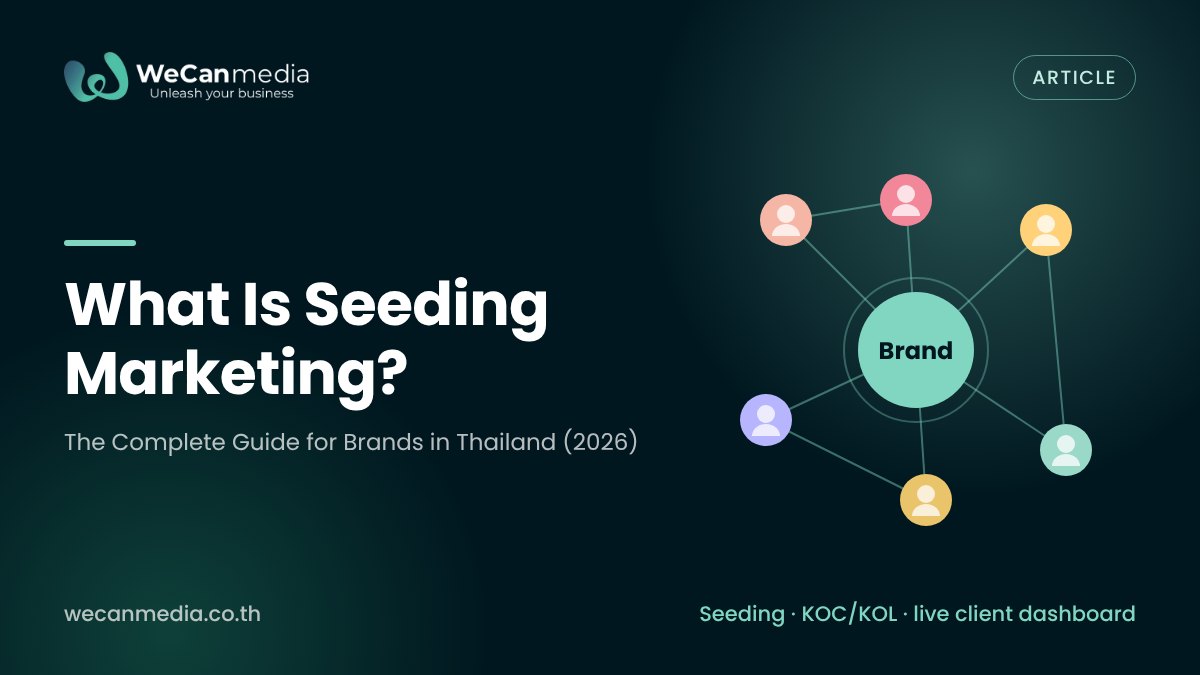
Seeding (also social seeding or product seeding) means planting conversations about a product in the online communities where your audience already is, by having real consumers (KOCs, Key Opinion Consumers) who tried the product talk about their experience where other people are looking for information:
- Review posts in Facebook groups (product review, housewife, skincare and 7-Eleven deal groups)
- Comments, questions and answers under posts by the brand, by KOLs or by other members
- Short videos on TikTok, Instagram Reels and Facebook Reels
- Threads and comments on Pantip or Lemon8
The heart of seeding is volume plus naturalness. Instead of one celebrity mentioning a product in one post, seeding has hundreds of ordinary people mention it in hundreds of posts, spread across groups and time, until a reader feels “everyone seems to be using this lately”.
Why seeding works so well with Thai consumers
- Thais are among the heaviest Facebook group users in the world. The big Thai review groups have 1–1.4 million members and hundreds of new posts a day (see which groups fit your product in the group match tool).
- Buying decisions lean on ordinary people's reviews, more than on ads or celebrities, especially for affordable products sold at 7-Eleven or on Shopee.
- Group posts live long. Unlike an ad that disappears when you stop paying, a seeding post is found through the group's search for months.
- Low cost per reach. A photo post in a group costs ฿1,300–1,700 and reaches thousands to tens of thousands of members; 500 of them add up to reach that ads would need far more budget for.
Seeding vs influencer marketing
| Seeding (KOC) | Influencer marketing (KOL) | |
|---|---|---|
| Who speaks | Real consumers, hundreds to tens of thousands of followers | Influential creators, tens of thousands to millions |
| How many | Hundreds per campaign | 3–20 per campaign |
| Where | Facebook groups, comments, TikTok | The creator's own channel |
| What you get | Credibility, conversation, discoverability | Broad awareness, image |
| Price per piece | ฿200–1,700 | ฿1,920–112,000 |
The best campaigns use both: KOLs open the conversation and seeding makes it “real people are saying it too”. Read more in KOC vs KOL.
The seeding formats used in Thailand
1. Facebook group post seeding
The most cost-effective format for beauty, household, supplement and 7-Eleven products. KOCs post real product photos and their experience in 8–10 selected groups, rotating 7 formats (Listing, Voting, Combo, Product only, Review & Comparison, Result and Promo Search) so the feed stays natural. Read the 7 post formats and the Facebook group seeding service.
2. Comment seeding
The first 8 comments under a post are what tells the algorithm the post has a conversation. Good seeding posts come with seeding comments at a 1 : 8 ratio, and the same comments support brand page posts and KOL videos. Read why the first 8 comments decide a post's fate.
3. Like and engagement seeding
Not bot like-pumping, but a network of real KOC accounts liking, sharing and taking part at a natural pace, so brand posts have their first social proof before boosting. See engagement seeding.
4. KOC / KOL video seeding on TikTok and Instagram
Short videos from 30–100 KOCs over 4 weeks create a “keeps showing up” feeling on For You better than one celebrity video, and can be reused as Spark Ads. Read TikTok seeding.
How a seeding campaign runs (our actual process)
- Brief and key messages. What really sets the product apart, in everyday words: “breaks into water, absorbs fast, not sticky” rather than “Serum Burst Technology”.
- Choose groups and platforms by size, posts per day, engagement per post and the groups competitors already use (how to choose groups).
- Plan the content mix and schedule. Peak at launch, taper after, never more than 2 posts per group per day (plan generator).
- Recruit KOCs and ship the product. Real accounts with a history in those groups, who use the product before posting.
- Post plus comment seeding, first comments within 60 minutes.
- Measure and adjust. See which groups and formats work and shift the mix weekly (how to measure).
Where a seeding budget starts
From our published rate card (excl. VAT):
- Market test: 100 photo posts + 300 comments ≈ ฿300,000
- Product launch: 300 posts + 2,400 comments ≈ ฿1.18M
- Major campaign: 500 posts + 4,000 comments ≈ ฿1.72M
Unit prices step down at 500, 1,000, 1,500 and 3,000 units. Try your own numbers in the seeding cost calculator or read how much a seeding budget should be.
How to measure seeding results
What every report should show (more in how to measure seeding):
- Posts that went live, each with its link: every one can be opened, not just a total
- Engagement per post (the median), compared across groups and formats, so you know where to add weight
- Comments from real members and purchase questions like “where can I buy it?” or “how much?”, kept apart from seeding comments
- Share of voice in the target groups: how often the product comes up compared with competitors
- Search lift for the product name, and sales in the channels where it is sold
- Cost per engagement and per organic comment, to compare with ads
If the campaign uses KOC or KOL video too, check a creator's engagement rate before booking with the free engagement rate checker: just type the username.
What to watch out for
- Fake accounts and bots: cheap, easily removed, damaging to the brand and against platform rules
- Posts that read like ads: polished language and repeated scripts get removed by admins and spotted by members
- Overclaiming: cosmetics and supplements have their own advertising rules; read is seeding legal in Thailand
- No evidence: a report with totals but no post links cannot be checked. Our clients see every post with its link in the dashboard
In short
Seeding marketing creates real conversations by real people where customers already look for answers. It works especially well in Thailand because of how people use Facebook groups and trust ordinary reviewers. Doing it right means real accounts, real experience, rotated formats, controlled volume and measurement down to every post.