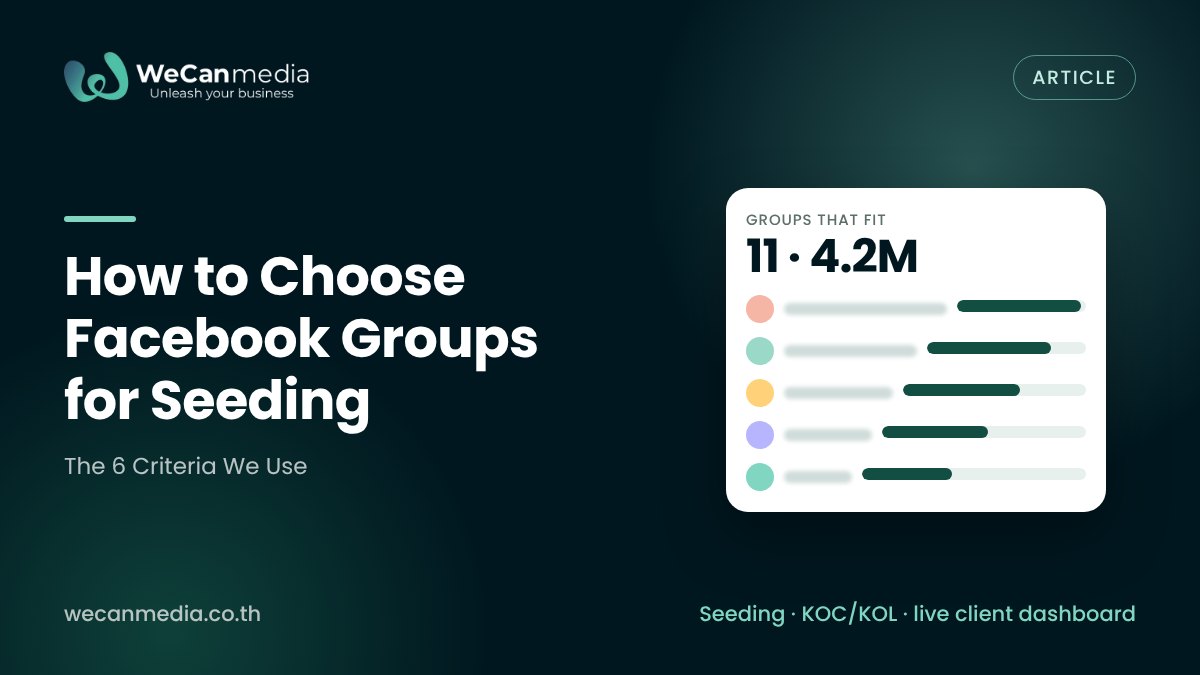
The biggest group is not always the best one. We have seen a post in a 1.4-million-member group get 12 likes, and a post in a 52,000-member group get 90 comments. The difference is the fit between product, members and the group's culture. These are the 6 criteria we check before a group goes into a seeding plan.
1. Do the members actually buy this product?
Read the last 50 posts: do members ask about your category, and is the price level similar? Housewife groups discuss ฿200–600 skincare; specialist skincare-knowledge groups discuss ingredients and pricier products. A counter brand doesn't belong in a 7-Eleven deal group.
2. Engagement per post, not member count
A quick method: scroll 20 ordinary member posts (not admin posts) and take the median likes and comments. A group where an ordinary post gets 30+ likes and 10+ comments is alive. A million-member group where ordinary posts get 3 likes is dead or throttled by the algorithm.
3. Posts per day and the approval queue
In a group with 300+ new posts a day your post leaves the feed in 2 hours, but the audience is huge and search finds it. In a group with 20–50 posts a day it stays visible longer. A good campaign mixes both, and you need to know which groups approve slowly (some take 1–2 days) to schedule correctly.
4. Admin strictness and group rules
Read the rules every time. Some groups ban links, some ban health product reviews, some require a “review” tag. Strictly moderated groups (skincare review groups run by doctors or pharmacists) carry high credibility but take low volume, 1–2 posts a month per KOC, and reviews must be reasoned. Groups that allow everything fill with ads until members stop reading.
5. Are competitors in this group?
Search 2–3 competitor names in the group. Many posts and comments mean members really discuss this category and competitors see value here. None at all may be an opportunity, or may mean the group doesn't care about the category; test with a few posts first.
6. Which formats the group accepts
Every group has its own language. 7-Eleven deal groups respond to Promo Search and receipt photos, housewife groups to Listing and Combo, skincare groups to Review & Comparison and Result. Read the 7 post formats and match them.
Example group sets by product type
Skincare / sunscreen (300-post budget)
- 3 large review groups (400K–1.2M members) take 60% of volume
- 3 specialist skincare groups (200–500K members) take 10%, quality first
- 3–4 mid-size housewife groups take 30%
Household goods
- Housewife and housework groups 70%
- Home lifestyle and decor groups 20%
- General review groups 10%
Products sold at 7-Eleven
- 4–5 7-Eleven deal groups (200K–1.4M members) 50%, especially during promotions
- 2–3 large review groups 40%
- Category-specific groups 10%
Check how many groups in our network fit your product category and request the shortlist with the Facebook group match tool.
Warning signs to skip a group
- More than half of recent posts are sales ads
- Members grow unusually fast while engagement stays flat (bought members)
- Admins openly sell pinned-post slots, so members know everything is an ad
- Posts naming brands get removed often for no stated reason
How to start
Choose 8–10 groups, split volume by tier, test for a week, then move budget to the groups with the best engagement per baht. Our clients see per-group numbers in the dashboard, so that decision can be made weekly. Read the full Facebook group seeding guide or see the service.